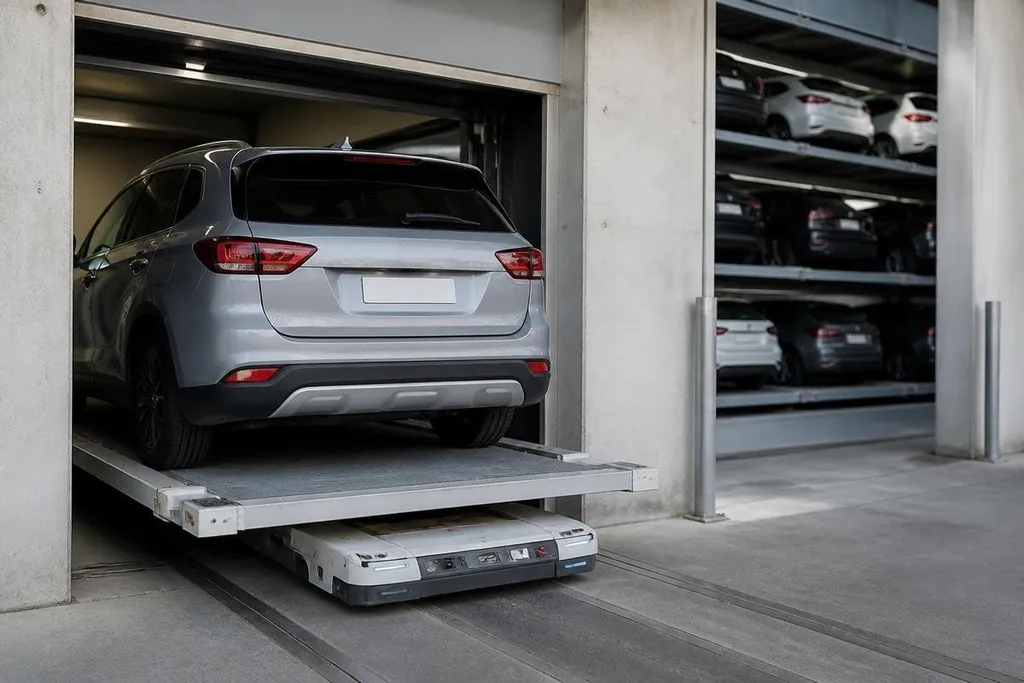
A parking robot takes control of the car after you leave it at an entry bay. It moves the vehicle to an open space and brings it back when you ask for it. That can change the layout of a garage, but it also puts every car behind software, sensors, motors, and a recovery process.
Quick read
- Robot parking can reduce the room needed for driving lanes and pedestrian areas.
- The main risks are faults, slow retrieval, fire response, and access problems.
- A buyer should test the failure plan before comparing storage capacity or price.
Where the space saving comes from
A normal garage needs lanes wide enough for people to drive, turn, open doors, and walk beside cars. A robotic system can place cars in tighter rows because the vehicle reaches its space on a guided platform or lift, rather than under its own control.
That can leave more of a site for parked cars or reduce the size of the building. The gain depends on the layout, the size of the entry area, the height available for lifts, and the space needed for service access. A vendor's diagram should show all of those areas, not only the storage bays.
The driver also leaves the vehicle at a controlled handoff point. People stay out of the storage area, which can reduce contact with moving cars and remove much of the low-speed driving that causes scrapes in tight garages. Barriers, sensors, warning signs, and a clear way to stop movement are still needed.
What the system has to do
A parking robot may use cameras, LiDAR, floor markers, lifts, pallets, or guided carts. The exact setup matters because each part creates a different failure point.
A pallet system needs accurate positioning. A lift needs brakes and backup power. A camera-based system needs a clean view of the car and the bay.
The handoff is where many practical questions start. At that point, it must confirm that the car is inside its allowed size and weight range, that doors and windows are closed, and that no person or object remains in the entry bay. A car with a roof box, a trailer hitch, or a low front bumper may need a different rule from a standard passenger car.
Retrieval time also needs a real test. A system may return one car quickly when the garage is empty, then take longer when several people request vehicles at once. Ask for the expected wait during a busy period and the process for a request that cannot be completed.
The busy-period test should sit beside the garage’s recovery rules. A buyer can use Robot 24 to check whether a parking system has been tested with blocked bays, lost signals, and manual retrieval. Those details lead into the risks that remain when the garage is full.
Where the risks sit
A software fault can stop new cars from entering, but the harder problem is a car already inside. The operator needs a safe manual recovery method, trained staff, and access to the right tools. A promise that a technician can fix the system is incomplete without a response time and a tested procedure.
Fire response needs its own review. Stored vehicles can block normal access for firefighters, while batteries, fuel, and charging equipment each bring different hazards. Ask how emergency crews reach the storage area, how the system isolates power, and how staff remove a vehicle when the controls are offline.
Accessibility can also fail at the entry point. A person may need extra time, a wider transfer area, or access to belongings before the car enters storage. The design should cover those needs without forcing people to stand beside moving equipment.
Privacy and security deserve attention too. Cameras may record plates, people, or vehicle movements. The operator should state what data the system records, how long it keeps that data, and who can open or retrieve a car.
A buyer's checklist
Use these questions before signing a purchase, lease, or service contract:
- Test a fault: Ask staff to recover a vehicle after a sensor or network failure.
- Measure retrieval: Record the wait for one request and a busy batch of requests.
- Check vehicle limits: Write down limits for height, length, width, weight, trailers, and roof loads.
- Review emergency access: Confirm how firefighters and service staff reach stored cars.
- Price the service: Include power, inspections, software fees, repairs, spare parts, and staff training.
- Set an outage rule: Ask what happens to new arrivals, stored cars, and customer refunds during downtime.
The decision
Robot parking fits sites where land is tight and a controlled handoff can replace much of the driving space. It fits poorly where people need instant access, vehicle types vary widely, or the operator cannot support recovery work.
I'd choose a system only after seeing its fault procedure in person. The space saving is easy to draw on a plan; the real test is getting a car back when the plan stops working.